


 Buy Online
 08 9671 1500
 office@dsatco.com
How Organic Mulch Reduces Evaporation and Protects Plant Roots From Heat
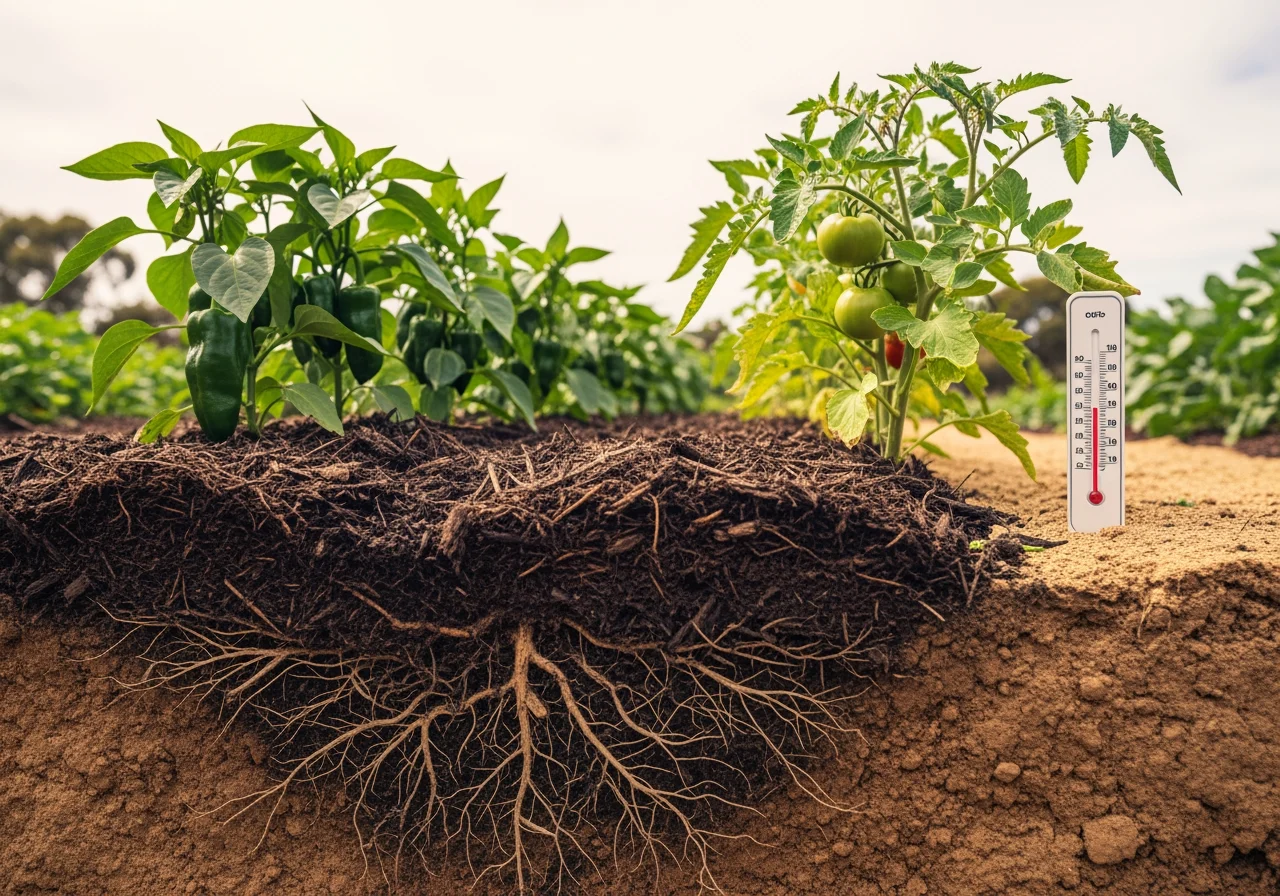
When Perth summer temperatures push past 38 degrees for consecutive days, the most damaging thing happening to your garden is not what is happening to the leaves visible above the soil. It is what is happening to the roots beneath it. Root systems operating in soil that has become too hot or too dry shut down the water and nutrient uptake that keeps plants alive. Mulch is the tool that prevents this — not by changing what is happening in the air above your garden, but by managing the conditions in the critical zone where roots live and work.
Evaporation control and root zone protection are the two most practically important benefits of organic mulch for Perth gardeners. Understanding exactly how mulch delivers each benefit helps you choose the right product, apply it at the right depth, and maintain it through the season when plants need it most. This guide covers the mechanics of each benefit and the practical steps that maximise their effect in Perth’s hot, sandy growing conditions.
Perth’s water restrictions make evaporation control especially critical. When you are limited to twice-weekly irrigation, every millilitre of applied water that evaporates before plant roots can access it represents both a water waste and a plant health cost. Mulch applied at the correct depth and maintained through summer is the most effective tool available for ensuring that the restricted water you apply actually reaches the roots that need it.
This is not about adding more product to your garden. It is about applying the right mulch at the right depth, in the right season, to solve the specific heat and water challenges that Perth summer creates.
Why Evaporation Control Is the Core Summer Challenge in Perth
The rate at which Perth garden beds lose moisture to evaporation under summer conditions far exceeds what most gardeners account for when planning their irrigation schedules. Sandy soil exposed to direct sun, low humidity, and easterly winds can lose moisture at a rate that makes the available water capacity of untreated sand irrelevant — the moisture is gone before it can be drawn into the root zone by transpiration.
DSATCO Lupin Mulch is the most effective mulch water saving Perth gardeners have available for high-value beds where evaporation control matters most. Made from WA lupin plant material and chicken manure, it forms a dense, stable surface layer that resists the wind displacement that undermines lighter mulches in Perth’s gusty summer conditions. Applied at 50 to 75mm depth before November, it delivers evaporation control from the first hot days of the season through the full summer period.
How Much Water WA Gardens Lose to Evaporation
The majority of moisture loss from Perth garden beds during summer happens at the soil surface rather than through plant transpiration. Hot soil drives moisture upward by capillary action and releases it into dry air through evaporation. Wind removes this moisture-laden surface air and replaces it with dry air, maintaining the vapour pressure gradient that drives continued evaporation.
In bare sandy soil, this process is limited only by how much moisture the soil contains. Heavily irrigated bare beds in Perth summer can cycle from adequate to critically dry within a single hot afternoon. Mulch interrupts the surface evaporation mechanism by placing a physical barrier between the moist soil below and the evaporative conditions above.
Why Root Zone Protection Matters as Much as Moisture Retention
Protect plant roots is the second critical function of mulch in Perth summer conditions, distinct from surface evaporation control. Even when adequate moisture is present in the root zone, plant roots cannot absorb it efficiently if soil temperatures are too high. Fine feeder roots — the ones responsible for the majority of water and nutrient uptake — are damaged or lose function at temperatures that Perth’s bare sandy soil regularly reaches during summer afternoons.
DSATCO is a Western Australian company that produces premium organic mulch and garden products, grown and sourced 100% from WA farms. The mulch heat protection that DSATCO products provide is built into their product formulation — dense, composted organic material that both insulates the soil surface from radiant heat and maintains the humid microclimate that keeps root zone temperatures within functional range.
How Mulch Reduces Evaporation at the Soil Surface
The physics of evaporation reduction through mulching are straightforward. Evaporation from a soil surface requires three conditions: moisture present at the surface, energy input sufficient to convert that moisture to vapour, and air movement to carry the vapour away. Organic mulch interrupts all three.
DSATCO Piggypost applied before mulching builds the root zone conditions that work in combination with surface mulch for maximum protection. This mature compost product incorporated into the top soil layer improves the soil’s internal water distribution, keeping moisture available in the root zone even as the surface dries under the mulch layer. The combination of improved soil water-holding from Piggypost and reduced surface evaporation from mulch delivers the most comprehensive soil moisture protection available.
The Shading Effect on Soil Surface Temperature
Direct solar radiation is the primary energy source driving surface evaporation from Perth garden beds. The soil surface absorbs this radiation and heats up. Water molecules at the heated surface gain enough energy to evaporate. Mulch blocks or absorbs much of this radiation before it reaches the soil surface, reducing the energy available to drive evaporation.
The shading effect of mulch on soil temperature is its most immediate benefit on the day of application. Mulch evaporation WA gardeners observe in reduced surface drying under a freshly applied layer reflects this rapid temperature reduction — soil shaded from direct sun loses moisture measurably more slowly than bare soil under identical conditions.
The Dry Insulating Layer and Humidity Microclimate
As the top of the mulch layer dries out, it creates a second evaporation-reduction mechanism. The dry outer layer conducts heat poorly, slowing the transfer of thermal energy from the warm air above down to the soil surface below. This insulation effect maintains a temperature gradient between the warm mulch surface and the cooler, moister soil-mulch interface.
Within this interface zone, evaporation from the soil slows because the air is already relatively humid. The vapour pressure gradient that drives evaporation — the difference between the high moisture concentration at the evaporating surface and the low moisture concentration in the air above — is smaller within the mulch microclimate than above bare soil. The soil temperature mulch maintains at this interface is significantly lower than at the surface of bare soil, and it is this soil temperature mulch effect that allows moisture to persist in the root zone through afternoon heat peaks. The result is protect plant roots conditions that persist even when surface air temperatures are at their daily peak.
How Mulch Protects Plant Root Zones From Heat
DSATCO Triple-C Mulch is particularly effective for root zone protection in established garden beds, native plantings, and ornamental areas where long-lasting surface coverage is needed. Its composted consistency provides stable, dense coverage that insulates the root zone through extended hot periods without breaking down rapidly enough to require frequent replacement during summer.
Root zone temperatures under a properly maintained mulch layer can be substantially lower than in bare soil under the same conditions. This temperature buffering keeps fine feeder roots within the functional range on days when surface air temperatures push well above 38 degrees.
The Temperature Range That Roots Need to Function
Most garden plants have root systems that function optimally within a soil temperature range well below the surface temperatures Perth soils reach in summer. Above this optimal range, fine root function slows. At the temperatures unprotected Perth sandy soil reaches, root damage can occur that affects plant performance for weeks after the heat event, even when the plant above ground appears to recover.
Mulch heat protection from a consistently maintained 50 to 75mm layer significantly reduces the risk of root temperature damage during Perth’s summer heatwaves. The plants most susceptible — those with shallow root systems like vegetables, annual flowers, and young transplants — benefit most dramatically from root zone protection in WA garden conditions.
How Mulch Prevents Soil Surface Crusting
When bare sandy soil dries completely under Perth summer heat, it can form a surface crust that becomes water-repellent. Water applied to this crust through irrigation either runs off the surface or takes far longer to penetrate to the root zone than it would in uncrusted soil. This hydrophobic crust is one reason why summer garden irrigation sometimes appears to disappear without reaching plants — the water is running off rather than soaking in.
Mulch prevents this crusting by maintaining soil contact with a protective organic layer. The soil surface beneath mulch stays friable and permeable, allowing irrigation water to penetrate immediately and efficiently. This penetration efficiency means that the restricted water allowed under Perth’s summer irrigation rules actually reaches roots rather than being lost to surface runoff.
Choosing Mulch for Evaporation Control and Root Protection in WA
DSATCO Sugar Cane Mulch suits vegetable gardens and annual beds where soil temperature and moisture consistency in the top 10 to 15 centimetres of soil is the priority. Its lighter texture allows effective water penetration when you irrigate while still providing meaningful evaporation control and root zone protection for the shallow-rooted crops that are most sensitive to soil temperature fluctuations.
Matching mulch product to garden type affects both evaporation control performance and the longer-term soil improvement that sustains root protection benefits. Nitrogen-rich mulches like lupin mulch suit high-production beds where feeding soil biology alongside protection is valuable. Composted blends suit established beds where stable long-term coverage matters more than rapid breakdown.
Pre-Application Soil Preparation
Water garden beds thoroughly 24 to 48 hours before mulching. This gives moisture time to penetrate to root depth, and the mulch application then locks that moisture in place rather than simply covering dry sand. Dry soil under mulch stays dry — mulch is a moisture preserver, not a moisture creator.
DSATCO Lawn Maximizer applied as a topdressing to lawn areas before summer extends the root zone protection principle to turf. Kikuyu, couch, and buffalo lawns manage summer heat stress more effectively when the soil beneath them has higher organic matter content — the same principle that applies to mulched garden beds.
Depth, Coverage, and Maintenance Through Summer
Apply organic mulch at 50 to 75mm settled depth. Check coverage every six to eight weeks through summer — mulch breaks down faster in warm, moist conditions, and the protective layer thins. When it drops below 40mm, the evaporation control and root zone protection benefits reduce. A mid-season top-up of 20 to 30mm restores effective protection without requiring a full fresh application.
The full DSATCO product range is available online with bulk bag options for home gardeners who want to cover all beds comprehensively before summer arrives. Buying in bulk ensures you have enough product to apply at the correct depth across your full garden area rather than applying too thin because you underestimated how much you needed.
Browse the full range online or speak to the team on 08 9671 1500 about the right product for your beds.
Latest Posts
- How to Stage Bulk Bags For Soil Improvers Versus Lawn And Mulch
- How to Size Multi-Bed Garden Orders From Bulk Bag Coverage
- Coordinating Metro Stockists Sourcing and Bulk Transport for Large Projects
Reviews from
Happy Gardeners
 "Results have been spectacular. The grass has never looked healthier."
Rod


