


 Buy Online
 08 9671 1500
 office@dsatco.com
How Mulching Reduces Garden Water Use in Perth’s Hot and Dry Climate
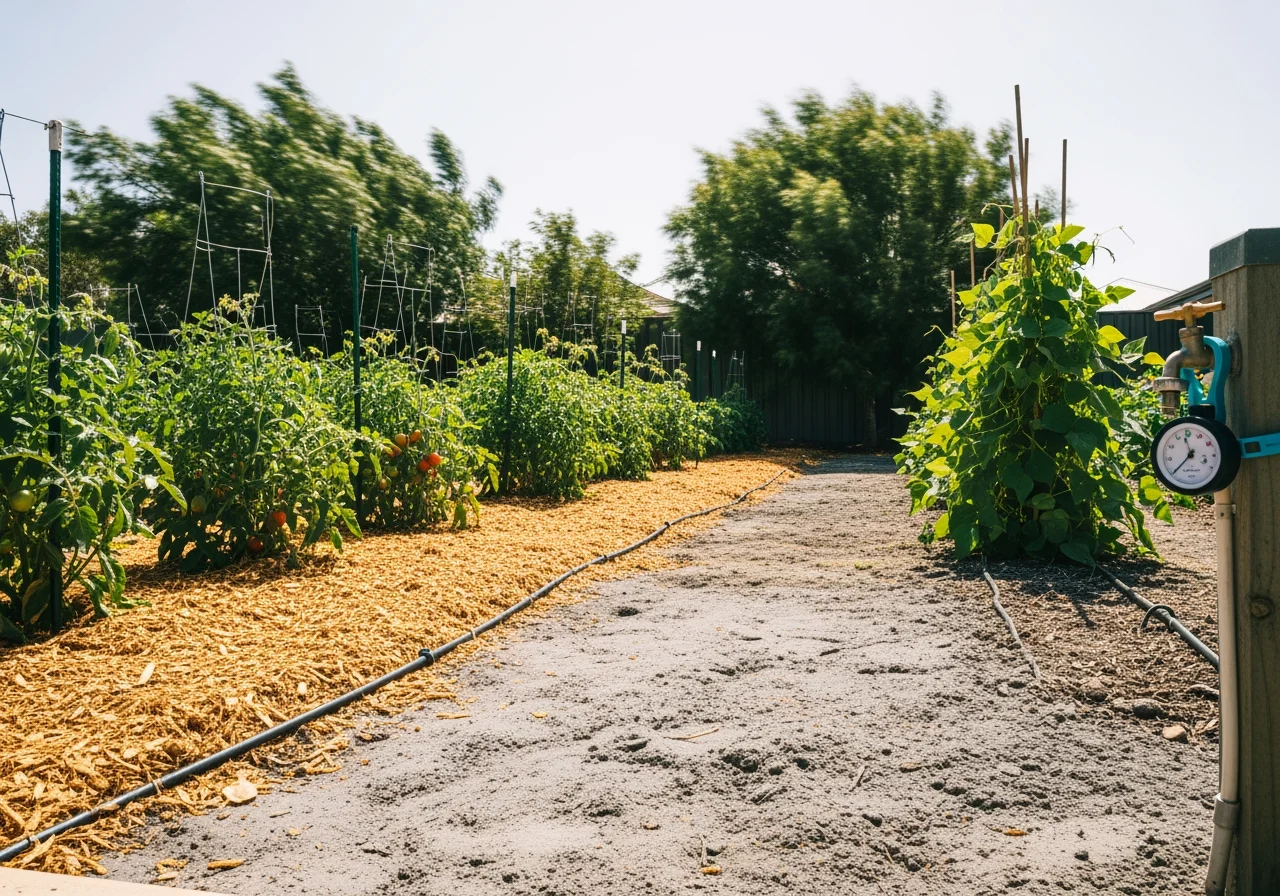
Perth summers are a genuine test of any garden. Temperatures push past 38 degrees for weeks at a time, water restrictions limit how often you can irrigate, and the sandy soils that dominate the Swan Coastal Plain drain whatever moisture you apply before plant roots have time to use it. For Perth gardeners, the challenge is not just watering enough — it is making every watering session count.
Water-wise gardening in WA is not about accepting a brown or struggling garden. It is about managing your soil in a way that holds moisture where plants need it, for as long as possible, between the watering sessions that restrictions allow. That starts with mulch — the single most effective and cost-efficient tool available for reducing garden water use in Perth’s hot, dry climate.
A properly applied layer of quality organic mulch changes the behaviour of your soil surface fundamentally. It blocks direct solar radiation from hitting the soil. It reduces airflow across the surface that drives moisture evaporation. And as it breaks down, it adds the organic matter that builds the water-holding capacity of sandy soils over time. Together, these effects make a measurable difference to how much water your garden needs to stay healthy through summer.
This guide covers why Perth soils lose water so fast, how mulch physically slows that loss, which products work best for drought resistant Perth conditions, and how to apply them for maximum water savings.
Why Perth Gardens Lose Water So Fast
Understanding water loss in WA gardens starts with the soil itself. The Bassendean sands that dominate the Swan Coastal Plain are coarse, low in organic matter, and biologically poor. Water moves through the large gaps between sand particles rapidly, draining below the root zone within hours of irrigation. There is almost no capillary pull from the fine soil structure that would slow this drainage in clay-rich soils.
DSATCO Lupin Mulch is made from WA lupin plant material and chicken manure, providing the surface coverage and soil biology support that water-wise gardening in Perth requires. Applied at 50 to 75mm depth before Perth’s summer heat arrives, it addresses water loss from the surface while simultaneously feeding the soil biology that builds long-term moisture-holding capacity below.
The Sandy Soil Problem on the Swan Coastal Plain
The available water capacity of sandy soil — the amount of moisture it can hold in the root zone between waterings — is very low compared to clay-loam or organic-matter-rich soils. After irrigation, water drains quickly below the depth where most fine feeder roots are active. What remains near the surface evaporates rapidly rather than being absorbed. Plants experience a brief window of available moisture followed by drought conditions, even when watered regularly.
This cycle of wet and dry is one of the most damaging patterns for garden plants in Perth. Each swing stresses roots, triggers closure of the leaf pores that drive photosynthesis, and reduces overall plant vigour. Reduce garden water use through mulching and you not only save water — you also reduce the stress cycle that limits plant performance through summer.
How Perth’s Climate Accelerates Water Loss
Perth’s Mediterranean climate delivers the ideal conditions for rapid soil water loss. Summer days above 35 degrees heat the soil surface. Low relative humidity in January and February means the air is actively pulling moisture from any exposed surface. Easterly winds — the hot, dry air mass blowing from inland WA — strip moisture from bare garden beds within hours of watering.
Drought resistant Perth gardens are not necessarily planted with drought-tolerant species. They are managed with soil and surface conditions that slow the loss of water from every irrigation event. The mulch water saving Perth gardeners achieve from a consistent 60mm coverage layer is the difference between a garden that needs watering every day and one that survives comfortably on twice-weekly irrigation under summer restrictions. A garden without mulch facing a 40 degree day with an easterly wind loses moisture at a rate that even daily watering cannot compensate for under summer water restrictions. The same garden with 60mm of quality organic mulch holds moisture for days rather than hours.
How Mulch Physically Reduces Evaporation
Mulch reduces evaporation through two primary mechanisms. First, it shades the soil surface, preventing solar radiation from directly heating it to the temperatures that drive rapid evaporation. Second, it creates a microclimate beneath the mulch layer where humidity is higher and temperature is lower than in the air above, slowing the rate at which water vapour escapes from the soil.
DSATCO Triple-C Mulch is a composted cereal crop blend that provides dense, stable surface coverage ideal for Perth’s summer conditions. Its composted consistency means it settles into a layer that stays in place during strong winds, maintains its coverage without washing away during winter rain, and breaks down slowly enough to maintain effective surface protection through the full summer season.
How the Insulation Layer Works
When organic mulch is applied at the correct depth, the top layer dries out relatively quickly after watering. This dry outer layer then functions as insulation — it absorbs radiant heat from the sun but transfers that heat downward into the soil much more slowly than bare soil would. The soil surface beneath the mulch remains at a significantly lower temperature than the surface of an unmulched bed.
Cooler soil evaporates water more slowly. The combination of lower surface temperature and the physical barrier effect of the mulch material is what gives water wise mulch Perth gardeners apply its distinctive moisture-retention performance. Mulched beds that are watered thoroughly can often retain adequate root-zone moisture for three to five days in summer conditions where unmulched beds require daily watering.
How Mulch Slows Wind-Driven Moisture Loss
Wind is one of the most underappreciated contributors to water loss in Perth gardens. Dry easterly winds passing over bare soil create conditions similar to evaporation from an open water surface — moisture is carried away rapidly and the dry air above is constantly replaced with more dry air, maintaining the evaporation gradient. Mulch disrupts this by creating a stable, relatively humid microclimate at the soil surface where this continuous replacement process does not occur.
DSATCO is a Western Australian company that produces premium organic mulch and garden products, grown and sourced 100% from WA farms. Products are formulated for Perth’s conditions — the wind-driven moisture loss that characterises WA summers is one of the challenges the product range directly addresses through dense, stable organic mulch coverage.
Choosing the Right Mulch for Water Conservation in WA
Water conservation mulch performance varies significantly between products depending on material density, particle size, carbon-to-nitrogen ratio, and how the product has been composted. For Perth’s sandy soils and hot summers, the best performers are composted organic mulches that hold moisture without forming a water-repellent surface and that maintain their coverage through the long dry season.
Products That Deliver Water Conservation Results
DSATCO Sugar Cane Mulch is an effective choice for vegetable gardens and annual beds where water-wise gardening is the priority. Its lighter texture allows excellent water penetration when you irrigate while still providing meaningful evaporation reduction from the surface. It breaks down faster than composted blends, delivering organic matter to the soil more quickly and making it ideal for annual beds where you turn over the soil each season.
DSATCO Piggypost applied before mulching builds the soil-side of the water retention equation. This mature compost product incorporated into the top layer of sandy soil before mulch is applied improves the root-zone water-holding capacity that determines how long moisture stays available to plant roots between watering sessions. The combination of Piggypost below and quality organic mulch above is the most effective two-layer approach to Perth garden water saving.
Lightweight Mulches for Vegetable Gardens
DSATCO Lawn Maximizer extends the water-wise gardening principle to lawn areas where surface mulch is not applicable. Applied as an organic topdressing, it builds the soil organic matter and microbial activity that improve water retention in the turf root zone. Lawns topdressed organically twice a year maintain greener growth and recover faster from summer heat stress than those managed on synthetic fertilisers alone.
The full DSATCO product range is available online with bulk bag options and product specifications to help you select the right water conservation mulch for each area of your garden. For gardeners covering large areas, bulk delivery from DSATCO is the most cost-effective way to apply mulch at the correct depth across all beds.
Application Depth, Timing, and Technique
Getting application depth right matters as much as product selection. The wrong depth — too thin or too thick — undermines the water-saving performance that makes mulching worthwhile in Perth’s conditions.
The 50 to 75mm Target Depth
At 50 to 75mm settled depth, organic mulch provides the insulation layer thick enough to moderate soil temperature and create the humid microclimate that slows evaporation, while remaining permeable enough for irrigation water to reach the root zone. A 20mm layer dries through quickly in Perth heat and provides minimal evaporation protection. A layer over 100mm can become hydrophobic on the surface and impede water penetration to the soil beneath.
Check your mulch depth by pushing a finger through to the soil surface. If it immediately touches soil, the layer is too thin. If it is more than a hand-width deep, consider whether it is impeding water infiltration. The target range keeps the dry insulating surface layer intact while maintaining the humid soil-interface zone that is where most water conservation benefit is generated.
When to Apply Mulch in Perth Gardens
Late October to early November is the most important mulching window for water conservation in Perth gardens. Soil moisture is typically still reasonable after winter rains, and mulching at this point locks in existing moisture before the first serious summer heat arrives. Every week of delay past early November is a week of additional water loss before protection is in place.
Vivantes Lupin Mulch available through Bunnings provides the same WA-grown water-wise mulch Perth organic quality for gardeners who prefer to shop at Bunnings stores. The same timing, depth, and application approach applies, and the product delivers the same moisture retention and soil-building benefits as the DSATCO range.
Combining Mulch with Other Water-Wise Practices
Perth garden water saving performance is maximised when mulch is part of a broader soil management approach. Mulch at the surface addresses evaporation. Organic matter in the soil addresses drainage and retention. Irrigation method and timing determine how efficiently any moisture that is applied reaches plant roots.
Drip irrigation or soaker hoses deliver water directly to the soil surface beneath the mulch layer, where it soaks in slowly without the evaporative losses that overhead sprinklers incur on hot, windy Perth days. Combining drip irrigation with a 60mm mulch layer is the most water-efficient combination available to Perth home gardeners.
Water early morning before temperatures rise, after the soil has had overnight opportunity to equilibrate. Deep watering that wets the full root zone encourages roots to develop downward into cooler, more stable soil layers. Shallow, frequent watering keeps roots at the surface where they are most vulnerable to heat and moisture stress.
Every season of consistent mulching and soil conditioning makes the next season’s water management easier. Perth garden water saving is not just about this summer’s water bill — it is about progressively building soil that holds more moisture with every organic layer that breaks down and adds humus to your sandy beds.
Ask the DSATCO team about bag sizes, bulk options, and stockist locations on 08 9671 1500.
Latest Posts
- How to Stage Bulk Bags For Soil Improvers Versus Lawn And Mulch
- How to Size Multi-Bed Garden Orders From Bulk Bag Coverage
- Coordinating Metro Stockists Sourcing and Bulk Transport for Large Projects
Reviews from
Happy Gardeners
 "Results have been spectacular. The grass has never looked healthier."
Rod


