

 Buy Online
 08 9671 1500
 office@dsatco.com
How to Reduce Your Garden Water Use With Organic Mulch Products
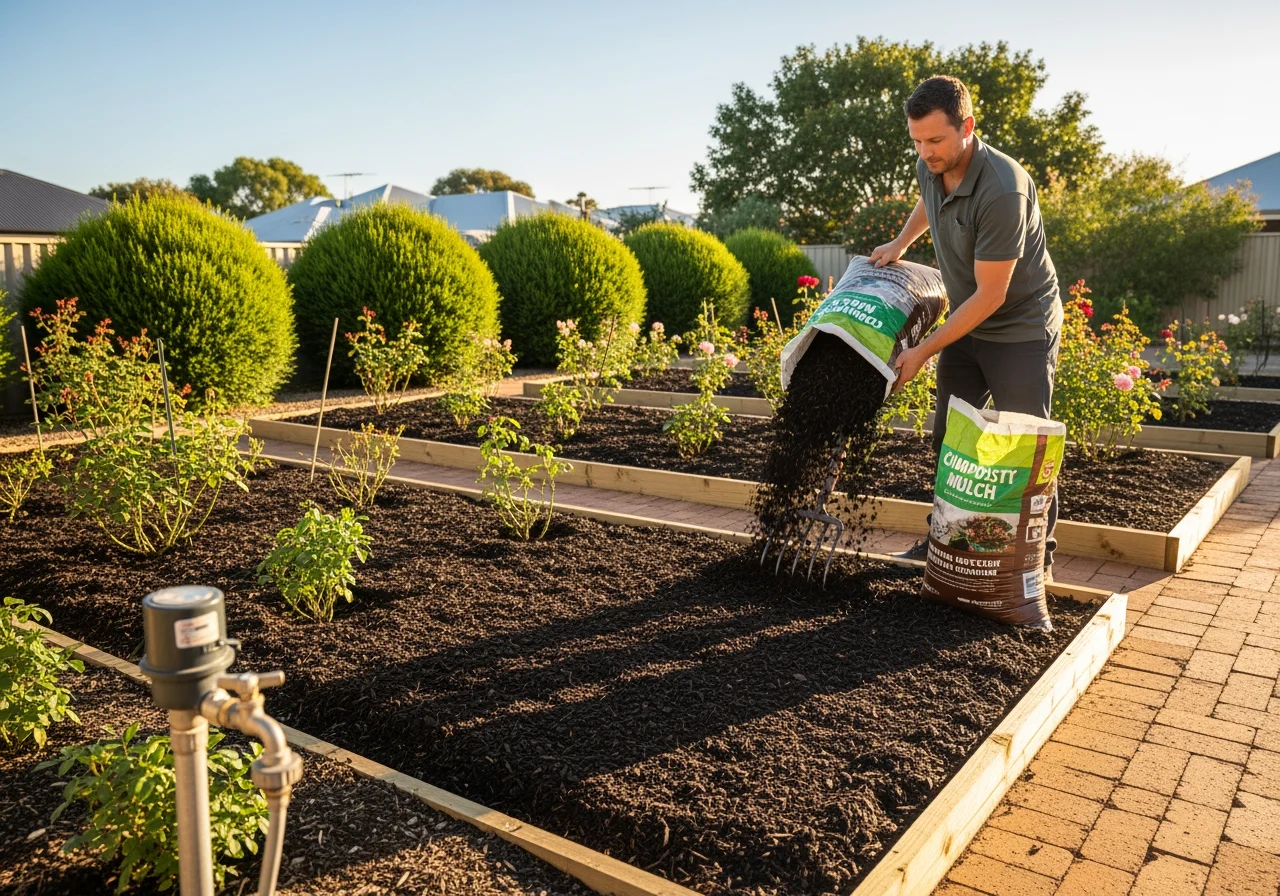
You have probably heard the theory: mulch saves water. But the practical reality is more specific and more rewarding than the general advice suggests. The right organic mulch, applied at the right depth, at the right time of year, does not just reduce water use a little. It changes how your soil behaves. It changes how long moisture stays in the root zone after you water. And over multiple seasons, it changes the soil itself — making it progressively more capable of holding water without you having to apply more of it.
That is the story of water conservation mulch in Perth. Not a one-season fix. A compounding investment that pays off more with each season of consistent application.
Perth home gardeners face specific water challenges: sandy soils that drain almost immediately, a six-month dry season with minimal natural rainfall, and water restrictions that limit irrigation to twice-weekly maximum. In that context, the gap between a garden that struggles through summer and one that thrives is often nothing more than 60mm of quality organic mulch applied consistently before October and maintained through March.
This guide covers which products deliver the best water conservation results, how to apply them for maximum effect, and why the water savings grow rather than plateau over the first few seasons of consistent mulching.
Why Organic Mulch Is the Most Practical Water Saving Tool for Perth
Among all the tools and techniques available to Perth gardeners, organic mulch delivers the broadest combination of immediate and long-term water saving benefits. It reduces surface evaporation on the day it is applied. It builds soil organic matter that progressively improves drainage and retention characteristics. And it supports the soil biology that creates and maintains the physical structure responsible for how soil holds water.
No irrigation system upgrade delivers all three of these benefits. Soil conditioners alone do not reduce surface evaporation. Plant selection changes take seasons to deliver meaningful water savings in established gardens. Water conservation mulch applied today starts saving water immediately while also building toward compounding savings in every subsequent season.
The Economics of Garden Water Use in Perth
Perth’s scheme water costs are real and increasing. The time spent managing a garden through summer under water restrictions is also real. Both motivate finding approaches that maintain plant health and garden appearance with less total water input. Organic mulch is the most cost-effective starting point because it delivers water savings across the full garden simultaneously, not just in specific zones.
The return on investment from quality organic mulch appears first in reduced irrigation frequency — gardens that were requiring daily attention during summer heatwaves often drop to twice-weekly without plant stress. Over three seasons of consistent application, the soil improvement contribution begins showing in reduced overall seasonal water consumption as sandy soil organic matter content rises.
Why Organic Outperforms Inorganic Alternatives for Water Conservation
Gravel, pebbles, and synthetic mulch products reduce evaporation at the soil surface. In that one function they can perform adequately. But they contribute nothing to the soil organic matter that is ultimately what determines how much water Perth’s sandy soils can hold between waterings. Organic mulch handles evaporation control and soil improvement simultaneously, making it the only product type that delivers low water landscaping benefits that grow over time rather than remaining static.
DSATCO Lupin Mulch is one of the most effective organic mulch water saving products available for Perth gardens. Made from WA lupin plant material and chicken manure, it combines dense surface coverage with a nitrogen-rich organic composition that feeds soil microbes and builds humus as it decomposes. The soil beneath a lupin mulch layer after two seasons of consistent application holds measurably more moisture between waterings than the same soil after two seasons without mulch.
Choosing the Right Water Conservation Mulch for Your Garden
Different garden types and soil conditions call for different mulch products. Matching product to application type gets better water saving results than applying any single product everywhere regardless of context.
DSATCO is a Western Australian company that produces premium organic mulch and garden products, grown and sourced 100% from WA farms. The product range covers every application scenario for Perth home gardeners, from intensive vegetable production to low-maintenance native gardens.
Lupin Mulch for High-Performance Water Retention
For vegetable gardens, rose beds, and productive ornamental borders, lupin mulch provides the best combination of immediate water saving and long-term soil improvement. The density of the material creates an effective evaporation barrier. The nitrogen-rich composition feeds the soil biology that builds the humus responsible for long-term moisture retention. And the mulch itself holds some moisture within its structure, acting as a reservoir that slowly releases to the soil below.
DSATCO Triple-C Mulch is the composted blend suited to established ornamental beds, native gardens, and any area where reduce water use Perth outcomes are the goal without the added nitrogen that lupin mulch delivers. Its slower decomposition rate provides stable coverage for up to 12 months between refresh applications, making it the most practical choice for large-area low-maintenance organic mulch water saving.
Composted Blends for Low-Maintenance Water Conservation
For Perth water restrictions mulch applications across large garden areas or lawn surrounds, composted blends provide the coverage depth needed for meaningful evaporation reduction with a single application that lasts through the full summer season. The composted consistency does not form a water-repellent surface when it dries — unlike some lighter organic materials — ensuring that irrigation water penetrates readily to the root zone throughout the dry season.
DSATCO Sugar Cane Mulch suits vegetable gardens and annual beds where the garden is worked regularly through the season. Lighter and easier to pull back for replanting, it provides effective water conservation mulch performance in high-activity growing areas. Its faster decomposition adds organic matter to the soil quickly, making it the best choice for building soil organic content in productive beds where fast turnover of organic material is desirable.
The Soil Conditioning Foundation for Maximum Water Saving
Surface mulch addresses the evaporation half of the water saving equation. The drainage half — how rapidly water moves through the sandy root zone — requires soil conditioning that changes the internal architecture of the soil.
DSATCO Piggypost applied before planting is the most effective way to improve the water-holding architecture of Perth’s sandy garden soils. This mature compost product is rich in stable humus and living microbes. Incorporated into the top 10 to 15 centimetres before mulching, it increases the root-zone available water capacity that determines how long moisture is accessible to plants between irrigation events.
How Piggypost Builds Water-Holding Capacity in Sandy Soils
Humus in composted manure products carries negative electrical charges that attract and hold water molecules, slowing the drainage rate of sandy soil. Living microbes introduced with the compost begin building the fungal networks and bacterial biofilms that further improve soil structure and water retention. The combined effect of humus addition and biological activation changes how sandy soil responds to irrigation within the first season of application.
Building the Two-Layer System for Perth Gardens
The most water-efficient garden configuration available to Perth gardeners combines Piggypost incorporation for root-zone moisture retention with quality organic mulch on the surface for evaporation control. This two-layer system reduces water loss at both the points where Perth gardens lose it most rapidly: the surface by evaporation, and the root zone by drainage.
For reduce water use Perth goals across an entire garden, plan the two-layer approach for each bed as you rotate through seasonal planting. Each time you establish a new planting, incorporate Piggypost, plant, and then apply organic mulch on top. Over two to three seasons of consistent practice, the cumulative effect on soil organic matter and water retention is dramatic.
Application Steps for Maximum Water Saving
DSATCO Lawn Maximizer extends the water saving principle to lawn areas where surface mulch cannot be applied. As an organic topdressing applied twice yearly, it builds the soil organic matter beneath kikuyu, couch, and buffalo turf that determines how efficiently grass roots access moisture between irrigation events. Lawns with higher organic matter soil hold moisture longer and green up faster after dry periods than those managed on synthetic fertilisers alone.
Water garden beds thoroughly 24 hours before applying mulch. This is the most frequently skipped step and the one with the biggest impact on first-week performance. Mulch applied over moist soil preserves that moisture through the first heat cycle after application. Mulch applied over dry soil locks in dry conditions — it cannot create moisture that was not there at application.
Depth, Timing, and Seasonal Maintenance
Apply mulch at 50 to 75mm settled depth. This is deeper than most gardeners instinctively apply, but it is the depth at which the insulation and humidity microclimate effects that reduce evaporation become consistently effective. A 20mm layer looks tidy but does not deliver meaningful water saving performance in Perth summer conditions.
The twice-yearly application rhythm — late October before summer and March to April into autumn — is the most efficient schedule for maintaining consistent water efficient garden WA coverage. Each application maintains the protective layer and adds fresh organic material to the decomposition process that builds soil carbon over time.
Pre-Application Watering and Soil Preparation
Remove existing weeds before mulching. This is part of the water saving strategy, not just tidiness. Weeds that establish under or through a mulch layer compete with garden plants for the moisture the mulch is protecting. Removing them before application eliminates this competition before it starts.
How Organic Mulch Delivers Long-Term Water Savings
The compounding nature of organic mulch water saving is what makes it such a valuable long-term Perth garden practice. Unlike synthetic mulches that simply cover the soil indefinitely without changing it, organic mulch breaks down and builds soil. Each season of decomposition adds to the organic matter content of your sandy beds, and each per cent of organic matter increase improves the soil’s moisture-holding capacity.
The water efficient garden WA outcomes from consistent organic mulching appear progressively over the first three seasons. The first season delivers the immediate evaporation reduction from surface coverage. The second season shows improved soil moisture retention as the first season’s decomposed mulch adds humus. By the third season, gardeners consistently report needing to water measurably less than in season one to maintain the same plant health outcomes.
The full DSATCO product range is available online, with Vivantes Triple-C Mulch for Bunnings shoppers who prefer to pick up in store. Both the DSATCO and Vivantes product ranges deliver the organic matter and microbial activity that drives long-term water savings in Perth’s sandy soils.
Low water landscaping in Perth is not about accepting a less productive or less beautiful garden. It is about building soil that supports healthy plant growth with less water. Organic mulch is the most direct path to that outcome — and the compounding nature of its benefits means the work you do this season pays off in every season that follows.
Every garden is different. Reach out to the DSATCO team for a product recommendation on 08 9671 1500.
Latest Posts
- How to Stage Bulk Bags For Soil Improvers Versus Lawn And Mulch
- How to Size Multi-Bed Garden Orders From Bulk Bag Coverage
- Coordinating Metro Stockists Sourcing and Bulk Transport for Large Projects
Reviews from
Happy Gardeners
 "Results have been spectacular. The grass has never looked healthier."
Rod


