

 Buy Online
 08 9671 1500
 office@dsatco.com
How Piggypost Improves Vegetable Gardens and Established Trees in Perth
Perth’s sandy soils lose nutrients fast. That’s not gardening folklore – it’s a structural reality that shapes how every vegetable garden and established tree performs across the Swan Coastal Plain. The solution isn’t more fertiliser. It’s building soil that can actually hold onto what you feed it.
This matters especially in Perth, where the combination of sandy loam, long dry summers, and rapid drainage creates conditions that defeat standard gardening approaches. Water disappears quickly. Nutrients leach away before roots can use them. The soil heats up faster than anywhere in WA’s temperate south.
For home gardeners trying to grow vegetables, fruit trees, or maintain mature trees on sandy Perth blocks, the challenge is consistent: the soil simply isn’t holding what you’re giving it. The good news is that this is a fixable problem – and the fix doesn’t involve more chemical inputs.
This article covers how composted pig manure works as a soil builder in Perth conditions, how to apply it correctly to vegetable beds and established trees, and how to pair it with mulch for results that compound season after season.
Why Perth Soil Needs More Than Fertiliser
The Problem with Sandy Soils on Perth’s Swan Coastal Plain
Perth’s soils are predominantly sandy and free-draining. Water moves through them fast. Soluble nutrients dissolve and follow the water straight down past the root zone. This is why so many Perth gardeners see yellowing leaves despite regular feeding. The nutrients are there – they’re just not staying where plants need them.
Organic matter is the missing ingredient. It binds to sand particles and creates structure. It acts as a sponge, holding water and nutrients where roots can actually reach them. Without it, sand behaves exactly like sand: it drains, it dries, and it doesn’t support the microbial life that healthy plants depend on.
What Makes Humus Different from Green Waste Compost
Not all compost is equal. Most bagged compost available in Perth is green waste – shredded garden clippings and woody material composted quickly to meet volume demand. While it adds some organic matter, it doesn’t always rebuild the soil’s foundation as effectively as a mature, animal-based amendment.
DSATCO Piggypost is composted pig manure that has been broken down over 12 to 18 months into stable, nutrient-rich humus. This dark, spongy organic matter transforms sandy Perth soil into something that behaves like real, productive garden soil. Standard green waste compost often breaks down too fast in Perth’s heat. Piggypost breaks down slowly, keeping soil healthy season after season.
How Piggypost Works in Vegetable Gardens
Perth vegetable gardens face two core challenges: nutrient leaching and poor water retention. Both stem from the same cause – sandy soil with almost no organic matter. When you dig fertiliser into sand, it usually drains straight through. Water moves fast and takes soluble nutrients with it.
Solving Nutrient Leaching in Perth Vegetable Beds
Working Piggypost into a bed changes this. It binds to sand particles and creates aggregates – small clumps of soil that hold together instead of draining like a sieve. These aggregates create air pockets for root growth and water-holding capacity that lasts. The result is soil that behaves more like loam than sand. Water soaks in and stays available for days.
This is a critical step in improving Perth vegetable gardens. Nutrients stay in the root zone where plants can actually use them, rather than washing straight through. For anyone searching for the best mulch for vegetable garden Australia has to offer, the answer often starts below the surface with the soil conditioner – not the mulch layer itself.
Achieving Consistent Growth Without Synthetic Inputs
Piggypost also delivers slow-release nutrition. As soil microbes break down the material, they release nitrogen, phosphorus, and potassium gradually. This supports consistent growth and heavy fruiting without the boom-and-bust cycle of synthetic fertilisers. Pairing Piggypost with DSATCO Sugar Cane Mulch on top of the bed locks in moisture and keeps the soil biology working through Perth’s hottest months.
If you’re growing in raised beds, Piggypost is even more effective. Raised beds drain faster than in-ground beds, meaning they lose organic matter quickly. A 50mm layer dug into the soil each season keeps the bed productive and reduces the need for constant feeding.
Application method for vegetable gardens: Spread Piggypost evenly across your bed at 40 to 50mm depth. Dig it into the top 150 to 200mm of soil. Water the bed thoroughly after application. This activates the microbial life and starts humus binding to sand particles. For best results, let the bed rest for a week before planting.
How to Apply Piggypost Around Established Trees
Established trees in Perth often look healthy on the surface but struggle below ground. Sandy soil doesn’t support deep, healthy root systems. Nutrients leach away before roots can access them. Water drains so fast that trees rely on seasonal rainfall to survive. This makes a quality tree soil fertiliser a practical necessity for long-term health in WA conditions.
Using the Drip Line Method for Tree Health
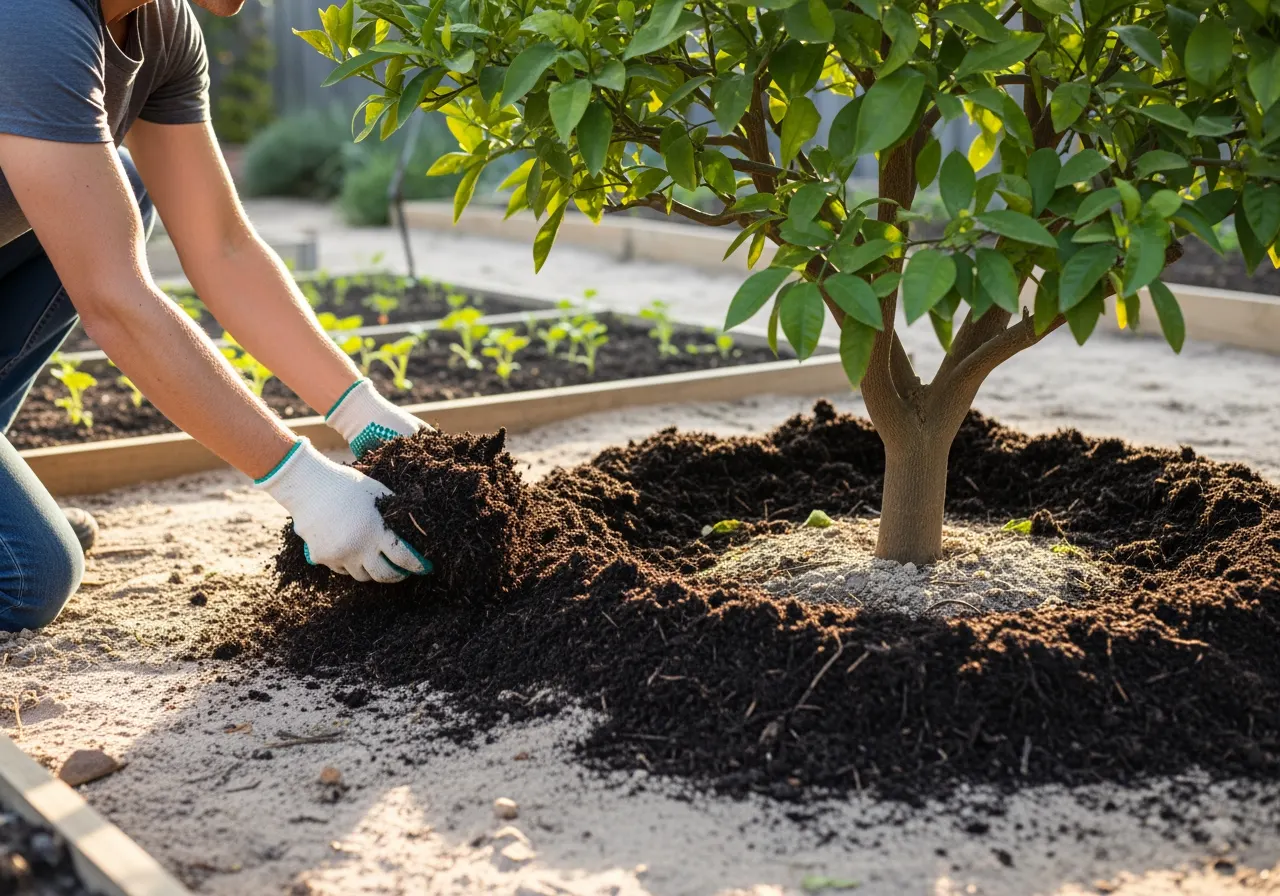
Unlike garden beds, you don’t dig Piggypost in around established trees. Instead, apply it as a top layer and let nature do the work. Spread it evenly around the tree’s drip line – the outer edge of the canopy where feeder roots are most active. Apply at 50mm depth in a ring that extends from 500mm away from the trunk out to the canopy edge. Never pile it against the trunk, as this can cause collar rot.
Mature eucalypts, banksias, citrus, and ornamental trees like jacarandas all benefit from this approach. The organic amendment rebuilds the soil around their root systems without disturbing them. While Piggypost feeds the trees, lawn areas nearby may benefit from DSATCO Lawn Maximizer to maintain a lush, green carpet without competing with tree roots for bulk organic matter.
Long-Term Benefits for Drought Tolerance and Pest Resistance
Trees that receive regular organic amendments develop deeper, denser root systems. This makes them more drought-tolerant and more stable in high winds. It also makes them more resilient during Perth’s extreme summer heat, when shallow-rooted trees often drop leaves or go into stress dormancy.
The microbial activity that Piggypost supports also protects trees from soil-borne pathogens. Beneficial fungi and bacteria outcompete disease-causing organisms. For citrus trees in particular, this addresses chronic nitrogen deficiency that shows up as pale yellow leaves. You can browse the full DSATCO range online to find specific solutions for your tree types.
Why Organic Amendment Outperforms Synthetic Fertilisers in Sandy WA Soil
Synthetic fertilisers deliver nutrients fast – often too fast for Perth’s sandy soil. When you apply a granular fertiliser to a vegetable garden or around a tree, nutrients dissolve immediately. In clay soils, this isn’t a problem. In sand, they leach straight through the root zone.
Biological Nutrient Release vs Fast-Acting Synthetics
Piggypost delivers nutrients slowly because they are locked up in organic matter. Soil microbes have to break down the material to release nitrogen and potassium. This process takes weeks to months, meaning nutrients become available at the rate plants can actually use them. This is the fundamental difference between feeding the plant and building the soil.
DSATCO is a Western Australian company that produces premium organic mulch and garden products, grown and sourced 100% from WA farms. Every Piggypost product is composted for 12 to 18 months and contains 70% humus along with living microbes that get to work immediately on application.
Building Soil That Gets More Productive Every Season
Synthetic fertilisers don’t improve soil structure. They don’t add organic matter or support microbial life. Over-reliance on them can actually degrade soil by killing beneficial microbes. Piggypost does the opposite. Every application builds the microbial ecosystem. For vegetable gardens, this means lower input costs over time. For established trees, it means long-term health instead of short-term fixes.
Combining Piggypost with Mulch for Maximum Impact
Piggypost works well on its own, but it works even better when paired with mulch. The two products address different parts of the soil health equation. Piggypost rebuilds structure and delivers slow-release nutrients. Mulch protects the surface and suppresses weeds.
Layering Piggypost and Mulch in Vegetable Gardens
In vegetable gardens, apply the soil conditioner first, then apply mulch on top after planting. For established trees, apply Piggypost around the drip line and cover it with a 75 to 100mm layer of DSATCO Lupin Mulch. This protects the biology from drying out in summer heat and helps carry nutrients down into the root zone as it breaks down.
Anyone looking for organic mulch Perth conditions can genuinely challenge would do well to combine a soil conditioner with a quality surface mulch. This combination is the fastest way to rebuild soil health on severely degraded properties. Mulch creates a stable, moist environment where beneficial microbes thrive, while the composted manure feeds them from below.
For garden beds that also need nitrogen and weed suppression, DSATCO Triple-C Mulch is a strong pairing with Piggypost. Its blend of cereal crops, chicken manure, and canola adds further slow-release nutrition while keeping weed pressure down across Perth’s long growing season.
Seasonal Application Timing for WA Gardens
Timing matters when applying any soil amendment in WA. The goal is to apply it when soil biology is most active and when plants can take advantage of the nutrient release.
For vegetable gardens, apply Piggypost in early spring (September) before summer crops, and again in early autumn (March) before winter crops. This matches Perth’s main growing seasons and ensures nutrients are ready when plants need them.
For established trees, apply in early spring (August to September) just before the main growth flush. A second application in early autumn supports root growth heading into winter. Avoid applying during Perth’s hottest months unless you can water it in thoroughly and keep it moist. High temperatures slow microbial activity, and dry material on the surface is less effective.
If you have questions about the best timing for your specific suburb, the Vivantes Lupin Mulch page also covers seasonal guidance for gardeners who source their products through Bunnings. For garden mulch Perth WA-wide options, Vivantes products are available at Bunnings stores across metro and country WA, giving gardeners convenient access to the same organic formulas.
Conclusion
Perth’s sandy soils don’t naturally hold the nutrients and water needed for thriving gardens. Composted pig manure rebuilds these problems from the ground up by delivering humus that creates lasting structure and feeds the beneficial microbes that plants and trees depend on.
For vegetable gardens, this means stronger seedlings and better yields season after season. For established trees, it means deeper roots and genuine drought tolerance heading into every Perth summer. By digging it into beds or spreading it around trees, you are creating a resilient garden that gets more productive every year. Pair your soil conditioner with mulch and time your applications with the seasons to get the best results from your WA garden.
Healthy soil pays for itself in every season. Find the right DSATCO product for your garden or call 08 9671 1500 for advice.
Latest Posts
- How to Stage Bulk Bags For Soil Improvers Versus Lawn And Mulch
- How to Size Multi-Bed Garden Orders From Bulk Bag Coverage
- Coordinating Metro Stockists Sourcing and Bulk Transport for Large Projects
Reviews from
Happy Gardeners
 "Results have been spectacular. The grass has never looked healthier."
Rod


