

 Buy Online
 08 9671 1500
 office@dsatco.com
How to Build Healthy Soil Structure in Perth’s Sandy and Alkaline Garden Beds
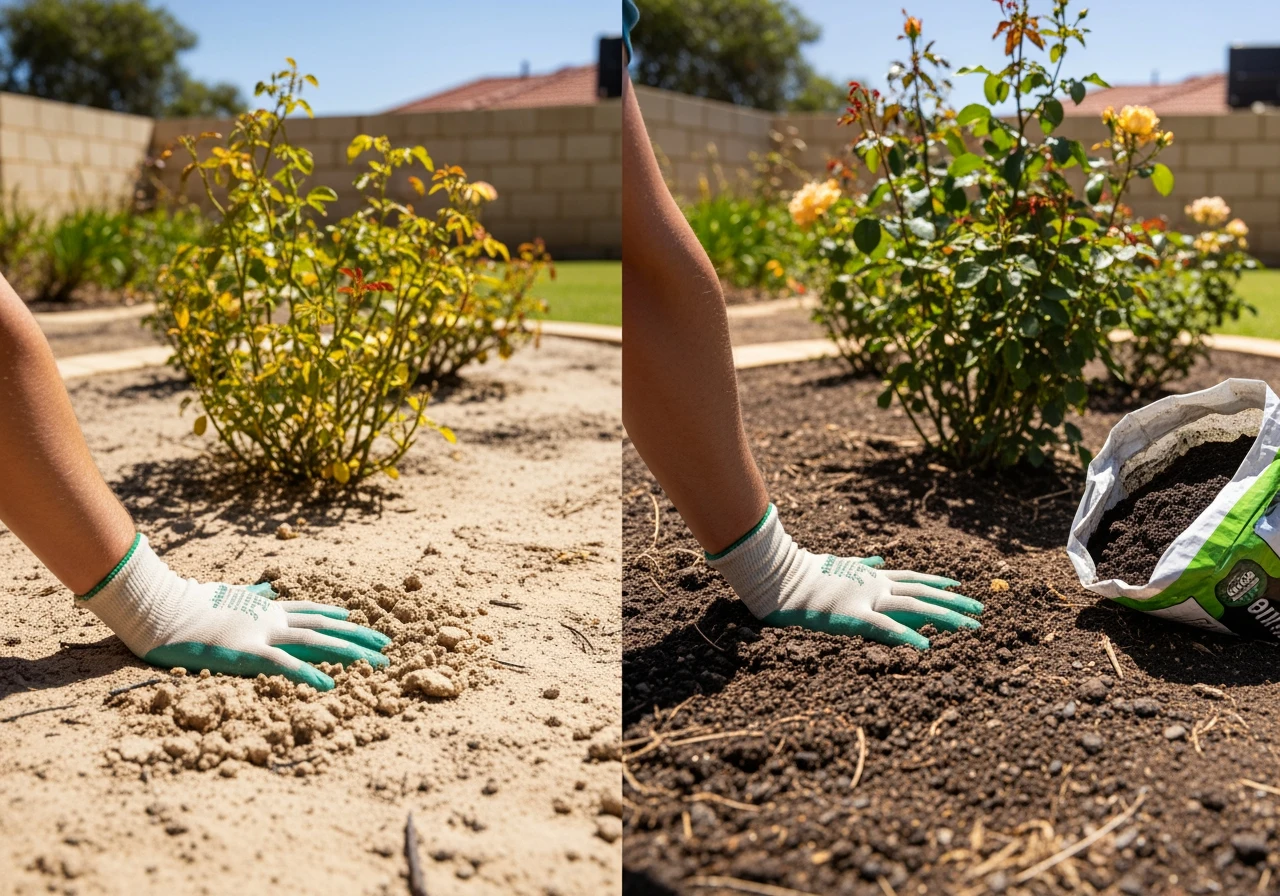
Walk out into a typical Perth garden, dig down 20 centimetres, and you will likely find the same thing: pale grey sand running through your fingers, dry and loose, barely distinguishable from beach sand. There is no crumb structure. No earthy smell. No earthworms. Just the raw building material of a productive garden waiting for the inputs that will transform it.
Sandy soil conditioning is the most important investment a Perth gardener can make, and the process is more straightforward than most people realise. You are not fighting an impossible soil type. You are supplementing what it lacks – organic matter, biology, and the physical binding that turns loose particles into a structured, productive growing medium. Perth’s sandy soils respond quickly to the right inputs because they have so much room for improvement.
The alkaline pH that many Perth soils carry adds a second layer of complexity. High pH locks up nutrients that are chemically present in the soil, making plants look hungry even when they are growing in amended, mulched beds. Managing soil structure Perth gardeners need means addressing both the physical structure problem and the chemistry that limits what an improved soil can deliver.
This guide covers the practical steps for building healthy soil structure in Perth’s sandy and alkaline garden beds, from the initial organic matter inputs to the long-term maintenance that keeps structure improving season after season.
Why Perth’s Sandy Soils Lack Structure
Soil structure is what you get when individual particles bind together into aggregates – small clusters held in place by organic matter, fungal networks, and the sticky compounds produced by beneficial bacteria. These aggregates create the pore spaces that hold water and air in the right balance for plant roots and soil biology to thrive.
Sandy soil lacks the clay particles that naturally encourage aggregation. Sand grains are large, smooth, and do not bind together without organic matter as a glue. Water moves through the spaces between them quickly, taking dissolved nutrients with it. Without organic matter and the microbial activity it supports, Perth’s sandy soils remain structureless – particles that sit next to each other but do not form the stable clusters that hold water and nutrients.
The Double Challenge of Sandy and Alkaline Soils
Most Perth garden soils are not just sandy – they are also alkaline. The carbonate-rich parent materials and naturally alkaline groundwater across much of the Swan Coastal Plain push soil pH above the neutral range. At pH above 7.5, iron, manganese, zinc, and phosphorus become chemically bound in forms that plant roots cannot absorb, even if those nutrients have been added in fertiliser or compost.
Sandy soil conditioning in Perth needs to address both problems simultaneously. Improving physical structure without managing pH leaves plants with better physical conditions but still unable to access the nutrients locked up by alkaline chemistry. Fortunately, the same organic inputs that improve physical structure also moderate pH over time, making a single integrated approach the most practical solution.
What Healthy Soil Structure Actually Looks Like in Perth Gardens
Healthy soil structure is visible, touchable, and smellable. Soil with good structure crumbles easily when you pick up a handful – it does not compact into a hard ball or fall apart like dry sand. It has a dark colour from accumulated organic matter and an earthy smell from biological activity. When you water it, water soaks in evenly rather than running off or draining immediately through.
In Perth garden beds that have been built up with organic matter over multiple seasons, the difference from raw sand is dramatic. The soil feels softer, holds together loosely, and moisture lasts for days rather than hours. Earthworms are present. Plant roots spread wide and deep rather than staying shallow in the more hospitable surface layer. This is the goal that sandy soil conditioning is working toward, and it is achievable in most Perth garden beds within two to three seasons of consistent organic inputs.
Step 1: Add Organic Matter That Builds Structure
The foundation of soil structure building in Perth is composted organic matter incorporated before planting. This is the most direct route to the humus that binds sand particles, the microbial populations that create biological structure, and the water-holding compounds that make sandy soil retain moisture.
DSATCO Piggypost is the most effective soil conditioner for building sandy soil WA structure from the root zone up. This mature compost product is made from pig manure processed to stable humus, rich in living microbes and organic carbon. Applied at a 50mm layer and dug into the top 15 to 20 centimetres of soil before planting, it begins transforming sandy soil immediately. The humus content binds to sand particles. The microbial populations colonise the root zone and start building the biological structure that improves water retention, nutrient cycling, and soil aggregation.
How Composted Manure Products Transform Sandy WA Soils
The key difference between Piggypost and raw organic matter like uncomposted manure or fresh wood chips is stability. Raw materials continue to decompose actively after soil incorporation, tying up nitrogen and creating unstable conditions. Composted materials have already passed through the most active decomposition phase. The humus they contain is stable, binding to soil particles and improving structure from the first application.
The living microbes in quality composted products are equally important. They colonise the sandy soil around them, extending fungal hyphae through the soil particles and producing the polysaccharides and glomalin that glue sand grains into aggregates. This biological structure building is what makes composted products so much more effective for improve soil structure goals than inert soil conditioners or synthetic amendments.
Application Rates and Timing for Maximum Structural Benefit
Work Piggypost into the top 15 to 20 centimetres before planting new beds. For established beds, top-dress with a 20 to 30mm layer and water in thoroughly to activate the microbial life. Autumn is the ideal timing for soil structure work in Perth gardens – cooling temperatures and returning rainfall create the conditions where biological activity peaks and organic matter integration happens most efficiently.
Step 2: Mulch to Feed and Protect the Improved Soil Surface
Once organic matter has been incorporated into the root zone, surface mulch protects and sustains the investment. Mulch feeds soil biology from the top down as it decomposes, protecting the structural improvements made below from summer heat and moisture loss while adding a continuous stream of organic carbon to the soil profile.
DSATCO Lupin Mulch is the most effective nitrogen-rich surface mulch for Perth garden beds where structural improvement is the goal. Made from WA lupin plant material and chicken manure, it feeds bacterial populations rapidly, delivering nitrogen that drives microbial processing of the organic matter below. As bacteria break down the lupin material over 6 to 12 months, they produce the polysaccharides and biofilms that bind sand particles into the aggregates that give Perth garden soil its structure.
Nitrogen-Rich Mulch for Garden Beds and Roses
For vegetable gardens, rose beds, and ornamental borders where heavy feeding meets structural improvement, lupin mulch is the most productive choice. Applied at 40 to 50mm depth and refreshed twice a year, it provides continuous organic carbon and nitrogen that sustains both plant nutrition and the microbial activity driving soil structure Perth needs to develop. Each application adds to the previous season’s structural gains.
DSATCO is a Western Australian company that produces premium organic mulch and garden products, grown and sourced 100% from WA farms. Products are formulated for Perth’s sandy, alkaline conditions – not adapted from eastern states formulations designed for different soil types.
Composted Blends for Low-Maintenance Areas
DSATCO Triple-C Mulch is a composted cereal crop blend suited to established ornamental beds, native plantings, and large-area coverage where a slower decomposition rate provides longer-lasting protection. For gardens where you want structural improvement without frequent reapplication, Triple-C maintains soil surface conditions and adds organic matter at a rate that suits low-maintenance management through Perth’s seasonal extremes.
For gardeners who prefer to shop at Bunnings, Vivantes Lupin Mulch delivers the same WA-grown organic material and structural soil improvement benefits in a format available through Bunnings stores. The same application rates and seasonal timing apply.
Step 3: Manage pH to Unlock Nutrients in Alkaline Soils
Sandy soil conditioning that improves physical structure without addressing alkalinity delivers incomplete results. Plants growing in better-structured soil still cannot access phosphorus, iron, or zinc that alkaline pH keeps locked up. Managing pH is the third element of the integrated approach that transforms Perth garden beds.
DSATCO Sugar Cane Mulch suits vegetable gardens and annual beds where you want a lightweight, slightly acidifying mulch that breaks down quickly and adds organic matter rapidly. For acid-loving plants like blueberries and azaleas in Perth’s alkaline garden beds, sugar cane mulch combined with a sulfur application provides both pH adjustment and the rapid organic matter addition that sustains the acidifying process over time.
How Organic Matter Moderates Alkaline pH
As organic matter decomposes, it releases organic acids that gradually shift soil pH toward the neutral range. This natural pH moderation is not dramatic or rapid – a single application will not move pH from 8.0 to 6.5 – but consistent organic inputs over multiple seasons progressively create more favourable chemistry for nutrient availability and soil biological activity.
DSATCO Lawn Maximizer builds organic matter and soil structure in lawn areas that are often the most pH-challenged in Perth gardens. Applied twice a year to kikuyu, couch, and buffalo turf, it improves the soil structure beneath the grass while the organic matter content moderates pH in the turf root zone over time.
Choosing Products for pH-Sensitive Plants
For most Perth garden plants – vegetables, roses, ornamental shrubs – the organic matter approach to pH management delivers sufficient improvement without the need for precise chemical adjustment. The full DSATCO product range provides every input needed for the integrated approach: composted soil conditioner for the root zone, organic mulch for the surface, and lawn products for turf areas.
For genuinely acid-loving plants, combine organic matter inputs with specific pH-adjusting amendments like sulfur or iron sulfate. The combination of chemical adjustment and consistent organic inputs produces the most stable, lasting pH improvement in Perth’s naturally alkaline garden beds.
Building Soil Structure Over Multiple Seasons
Sandy soil conditioning in Perth is a multi-season process. The physical transformation from loose, pale sand to structured, dark, biologically active growing medium takes consistent organic inputs over two to three growing seasons. Understanding the realistic timeline prevents discouragement and helps you recognise progress when it appears.
By the end of the first season, moisture retention noticeably improves in amended beds. Plant growth is stronger. The soil surface is darker where organic matter has begun accumulating. Earthworms may begin to appear in the most improved areas.
By the second season, soil texture is visibly different. Digging reveals crumbly, cohesive material rather than loose sand. Water infiltrates evenly without ponding or immediate drainage. Plants require less frequent watering and show fewer nutrient deficiency symptoms.
By season three, soil structure is largely self-sustaining. Biological activity is established and self-reinforcing. The need for large organic matter inputs reduces as the soil’s own biology maintains and builds on the structure you have created. You are gardening with your soil rather than fighting it – and the Perth garden soil you have built from improved sandy soil conditioning makes everything easier.
The right product makes the difference between an average garden and a great one. Explore the range or talk to DSATCO on 08 9671 1500.
Latest Posts
- How Finely Textured Sugar Cane Straw Aids Moisture Retentiveness
- When to Apply Sugar Cane Mulch to Sensitive Backyard Garden Borders
- Using Lawn Maximiser as an Organic Top Dress for Perth Domestic Turf
Reviews from
Happy Gardeners
 "Results have been spectacular. The grass has never looked healthier."
Rod


